Arrest, deportation and martyrdom
Arrest and Imprisonment
in Sachsenhausen
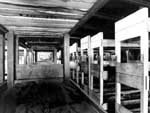 The
first arrest of Rev. Karol Wajszczuk took place on 28 April
1940. A black Gestapo car with two gendarmes arrived at the
rectory. After confirming the priest’s identity, the Gestapo
ordered him to get into the car immediately. The parish
priest took his breviary and calmly approached the organist
Antoni Patkowski to say goodbye, and to the people who
witnessed this he said: “Remain with God,” and drove away. The
first arrest of Rev. Karol Wajszczuk took place on 28 April
1940. A black Gestapo car with two gendarmes arrived at the
rectory. After confirming the priest’s identity, the Gestapo
ordered him to get into the car immediately. The parish
priest took his breviary and calmly approached the organist
Antoni Patkowski to say goodbye, and to the people who
witnessed this he said: “Remain with God,” and drove away.
After giving statements
first to the Gestapo in Międzyrzec and later in Radzyń, on
29 April he was released from prison and returned to Drelów,
but on condition that within three days he would provide
supplementary explanations at the Gestapo office in Łuków.
At that time people devoted to their parish priest advised
him not to trust the Germans and to leave in civilian
clothes for a safe place. However, he rejected this idea
because he had given his “priestly word” to the Gestapo that
he would submit the additional explanation.
On 2 May 1940 Rev.
Wajszczuk voluntarily appeared at the Gestapo headquarters
in Łuków to provide supplementary explanations. There he was
arrested again and on 3 May 1940 transported to Lublin. From
the district command building on Uniwersytecka Street, where
he was interrogated for several hours, he was transferred
the same day to the Nazi prison at Lublin Castle, which
during the occupation was one of the harshest places of
repression and martyrdom in the Polish lands.
When the priest’s
father, Piotr Wajszczuk, died in Siedlce on 20 May 1940, his
sister Maria made efforts at the Gestapo to obtain leave for
her brother so that he could attend the funeral. She was
informed, however, that Rev. Karol Wajszczuk had already
been transported from Lublin — information that was false,
as the transport took place later.
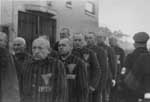 During
his imprisonment at the castle Rev. Karol Wajszczuk met Rev.
Stefan Ceptowski, with whom he shared suffering for nearly
two years. On 18 June 1940 both prisoners were transported
in freight wagons to Sachsenhausen concentration camp, where
they arrived on 20 June 1940. Rev. Karol Wajszczuk remained
in the camp until 14 December 1940 and was registered under
prisoner number 25746. During his stay he sent seven
censored postcards to his family in Siedlce and to friends,
especially organist Antoni Patkowski in Drelów. During
his imprisonment at the castle Rev. Karol Wajszczuk met Rev.
Stefan Ceptowski, with whom he shared suffering for nearly
two years. On 18 June 1940 both prisoners were transported
in freight wagons to Sachsenhausen concentration camp, where
they arrived on 20 June 1940. Rev. Karol Wajszczuk remained
in the camp until 14 December 1940 and was registered under
prisoner number 25746. During his stay he sent seven
censored postcards to his family in Siedlce and to friends,
especially organist Antoni Patkowski in Drelów.
Meanwhile, difficult
changes also occurred in the parish of Drelów. After Rev.
Wajszczuk’s arrest, serious transformations took place. By
order of the district governor in Radzyń of 25 May 1940 the
church and rectory were taken over by the Orthodox
administration, while Horodek was given to the Polish
community. Rev. Leon Gliszczyński, who replaced the parish
priest in Drelów, obtained permission to dismantle the organ
from the church. This was carried out in September 1940,
when organist Antoni Patkowski, with the help of
parishioners, transported the organ to Przechodzisko, where
it was stored in the home of Bazyli and Katarzyna Olesiejuk.
The canopy, church banners, liturgical vestments, vessels
and other objects of worship were taken by Rev. Gliszczyński
to Horodek.
Martyrdom
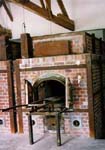 On 14 December 1940, as reported by the Polish Red
Cross headquarters in Warsaw, Rev. Wajszczuk was transferred
from Sachsenhausen to Dachau concentration camp, where he
received prisoner number 22572. In this camp the average
prisoner’s weight in 1942 was about 40 kilograms. On 14 December 1940, as reported by the Polish Red
Cross headquarters in Warsaw, Rev. Wajszczuk was transferred
from Sachsenhausen to Dachau concentration camp, where he
received prisoner number 22572. In this camp the average
prisoner’s weight in 1942 was about 40 kilograms.
In February 1941 his
sister Maria informed him about events in the parish of
Drelów, including the arrest of organist Antoni Patkowski,
who died in Auschwitz on 10 February 1942.
From March until the
end of the year correspondence with the family ceased, which
caused anxiety among his relatives. His mother’s request to
the Germans for her son’s release received a negative
response. Rev. Wajszczuk never learned about this refusal
and continued to hope for freedom.
From January 1942
letters from Dachau began to arrive again. In his last
letter of 17 May 1942 he wrote:
“I think that soon,
perhaps already next week, I will change my place of
residence; for now I remain here. When I am resettled, I
will write and give my new address.”
At that time he did not
realise that he would be placed on the so-called “invalid
transport,” which in reality meant death. On 28 May 1942 Rev.
Karol Wajszczuk was included in such a transport. According
to historical findings, prisoners classified as unfit for
work were transported from Dachau to the Hartheim euthanasia
center, where they were murdered in gas chambers as part of
the Nazi euthanasia programme.
Because the last
mention in camp documentation bears the date 28 May 1942,
this date is accepted as the day of death of Rev. Karol
Leonard Wajszczuk.
On 1 July 1942 the camp
command informed the family by telegram of his death. On 8
July his mother sent a letter to the camp commandant
requesting more detailed information. On 15 July a reply
arrived stating that her son had died “despite careful
medical care” of heart failure, circulatory insufficiency
and intestinal inflammation — a typical false cause of death
used in Nazi documentation.
His sister Maria, not
believing the German explanation, sought the truth about her
brother’s death. Jan Domagała, a former prisoner and clerk
in Dachau, wrote in a letter of 31 July 1946 that the term
“invalid transport” meant death.
|














)
)
)
