Early years
Karol Leonard Wajszczuk was born on 3 November 1887 in Siedlce. His
father, Piotr, was the son of a farmer from Trzebieszów, while his mother,
Marianna née Maciejczyk, born in Siedlce, came from a bourgeois family.
Karol had five siblings: a sister, Maria, and brothers Tadeusz, Edmund,
Albin Lucjusz, and Narcyz Zenobiusz. All the siblings, like Karol, received
very careful upbringing and solid preparation for life.
An atmosphere of piety and patriotism prevailed in the Wajszczuk household.
Memories of the January Uprising were vivid within the family. Recollections
of the events connected with the persecution of the Uniates in Podlasie in
1874 evoked fear. All this fostered an interest in the religious life of the
people.
During Karol’s childhood, an event occurred that determined the course of
his future life. It happened in the autumn of 1893. At that time the young
Karol fell seriously ill. For more than a week, tormented by a high fever
and unconscious, he struggled for his life. The doctor who had been called
spread his hands helplessly, stating that he had done everything in his
power and repeating: “The only help is in God.” Then his mother, kneeling
beside the bed of her dying son, devoted herself to prayer and, with tears
in her eyes, asked the Mother of God to restore his life and health; she
made a vow that if he survived, he would become a priest. The crisis passed
and the child slowly began to recover. The parents regarded this miraculous
recovery as a visible sign of God’s grace, and therefore Karol Leonard was
destined for the clerical state from his early years.
Initially, Karol was educated at home and for two years attended the
Municipal School in Siedlce; afterwards he studied at the Boys’ Gymnasium in
Siedlce, which he completed in June 1904. From June 1904 he began his
studies at the seminary in Lublin. After five years of study, in 1909 he
successfully completed the seminary, and on 29 June 1909 he received
subdiaconal ordination. In the autumn, on 4 November, he received diaconal
ordination. On 12 November the Lublin Diocesan Curia appointed Karol Leonard
Wajszczuk as vicar in Radzyń Podlaski; the nomination was signed by the
Bishop of Lublin, Franciszek Jaczewski. He took up this post on 21 November
1909. The people of Radzyń welcomed their new vicar very warmly, and this
goodwill probably contributed to the fact that on 6 February 1910 he
received priestly ordination.
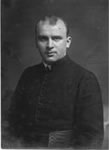 In
the first years of his work as vicar in Radzyń Podlaski, Rev. Karol also
served as prefect in the local school, led the church choir, and took an
interest in the life of the people. In
the first years of his work as vicar in Radzyń Podlaski, Rev. Karol also
served as prefect in the local school, led the church choir, and took an
interest in the life of the people.
In August 1914 the alliance of the three powers responsible for the
partitions of the Polish–Lithuanian Commonwealth collapsed. The
Commander-in-Chief of the Imperial Russian Army, Grand Duke Nikolai
Nikolaevich, issued an appeal to the Poles in which he promised the creation
of a Poland “united under the sceptre of the Emperor of Russia, free in
faith, language and self-government.” Rev. Wajszczuk reacted very
sceptically to this appeal and in one of his sermons in the autumn of 1914
reminded the faithful that “in Podlasie one must always remember the Uniates
who gave their lives for freedom of faith.” At that time Rev. Karol feared
arrest. However, the situation on the fronts determined a different course
of events. The Radzyń district found itself under German occupation.
The German occupation in Podlasie left a bloody mark. Hunger and poverty
became widespread in the town. Under these conditions dangerous outbreaks of
typhus and cholera occurred both in the countryside and in the town. The
Germans were panic-stricken by the epidemic. Rev. Wajszczuk, risking his
life, performed religious ministry by visiting the sick and burying the dead.
On 11 November, after 123 years of captivity, Poland regained independence.
Rev. Karol welcomed this day by celebrating Holy Mass and singing the hymns
Te Deum Laudamus and Boże coś Polskę.
At the beginning of January 1919, the Bishop of the Podlasie Diocese, Rev.
Dr Henryk Przeździecki, presented Rev. Karol L. Wajszczuk with a proposal to
transfer to Drelów, in the Międzyrzec parish, to serve as rector at a church
restored to the Catholic Church after 45 years since the liquidation of the
Uniate parish by the Tsarist authorities, in order to organise an
independent parish from the surrounding villages. The young vicar accepted
the proposal, and on 15 January 1919 he received the bishop’s nomination to
this post.
|













)
