While imprisoned in Sachsenhausen
concentration camp, Rev. Karol Wajszczuk demonstrated many noble acts. One
of them was described by Rev. Bartłomiej Stefan Ceptowski:
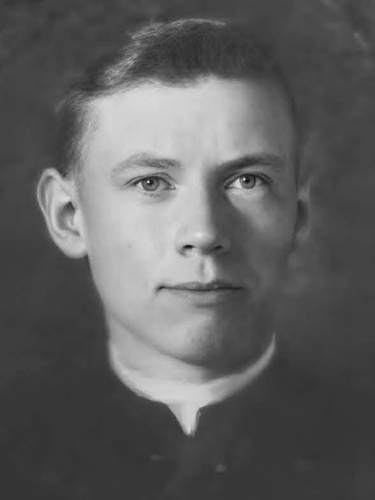 “Here is
another example of the heroism of the priest Rev. Karol Wajszczuk,
parish priest from Drelów of the Podlasie Diocese. After the terrible
quarantine ‘hüpfen rollen’ and other murderous persecutions at the
beginning of August 1940 in Sachsenhausen, we were assigned to camp work
according to the block leader’s allocation. I was assigned to one of the
heaviest labour details, the so-called ‘Kanalkommando.’
“Here is
another example of the heroism of the priest Rev. Karol Wajszczuk,
parish priest from Drelów of the Podlasie Diocese. After the terrible
quarantine ‘hüpfen rollen’ and other murderous persecutions at the
beginning of August 1940 in Sachsenhausen, we were assigned to camp work
according to the block leader’s allocation. I was assigned to one of the
heaviest labour details, the so-called ‘Kanalkommando.’
We marched to work to the sound
of a marching song at a fast pace, four kilometres each way. The journey
alone therefore amounted to sixteen kilometres daily. The work consisted
of unloading cargo ships onto land — coke, bricks, cement and coal. At
that time we were unloading coal, which was transported from the ship in
wheelbarrows along a narrow, unstable plank about one hundred metres
from the shore, where a large heap was being formed. We had to push the
loaded wheelbarrow up the plank to the top.
This work was beyond my strength,
and my body was already severely weakened by the brutal quarantine. On
the day I recall, with my last strength I managed to push three
wheelbarrows of coal; with the fourth, in the middle of the plank, my
strength failed. I cried for help — no one hurried. The wheelbarrow
slipped from my numb hands and fell into the water.
The kapo ordered me to jump into
the water to retrieve it. I looked around for help — my Polish brothers
were helpless and frightened, and the faces of the Germans were
merciless. Someone pushed me and I was already in the water, condemned
to death. And, strangely, the SS-man Kommando leader ordered that I be
pulled ashore unconscious. At noon I was carried back to the block in a
faint. Seeing my hopeless condition, the block leader did not send me to
work in the afternoon but left me in the block.
During the night my body
recovered a little so that I could muster all my strength to stand for
morning roll call, but it was difficult for me to walk. The block leader
again forced me to join my labour detail. My explanations that I was
powerless had no effect. In the camp there was room only for the healthy
and the dead — there was no place for the weak and the sick. When you
collapse, then you will be free from work. Out of his ‘good heart’ the
block leader even gave a fellow prisoner a rope to hang himself.
I knew that going to work I
would surely perish — if not on the way, then the kapo would not forgive
me for the wheelbarrow of coal that fell into the water. There was no
choice. I commended myself to God and stood in line for the ‘Kanalkommando.’
At that moment Rev. Karol
Wajszczuk approached the block leader — a priest from Podlasie, from my
diocese, about fifty-three years old, almost unknown to me before, as I
was barely thirty; in the camp we grew very fond of each other — and
asked that he be assigned in my place to work in that detail.
‘He is unfit for this work,’
said the block leader.
‘He is my compatriot; I am older
but still strong, and he is already half-dead, besides he is young — it
is a pity to waste him, but I am not a pity,’ replied the Polish priest
— a hero.
Hearing this, I shouted loudly
that I did not agree to the substitution; I would go myself and would
not allow him to go for me. It should be explained that those who worked
wore wooden clogs covering only the toes. The block leader said he did
not care who would go. Since I was wearing shoes and Rev. Wajszczuk had
clogs, I set off.
Then Rev. Wajszczuk suddenly
grabbed me, knocked me down — I had no strength to resist — pulled off
my shoes and put them on his own feet. The shoes turned out to be too
tight. The block leader shouted that it was time to go, so Rev. Karol,
limping from the tight shoes, chased after the labour detail that had
already set off.
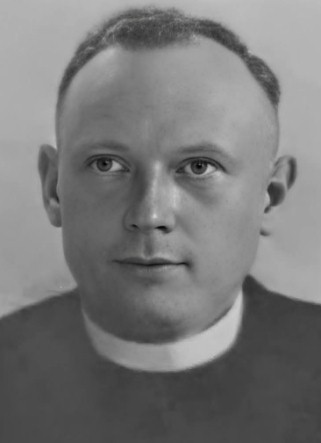 He went,
saving me from death, but he himself fell into its trap, because the
tight shoes prevented him from moving properly. They beat him severely,
and during work he injured his feet. He was later released from the
labour detail as unfit, and I was no longer called or searched for.
He went,
saving me from death, but he himself fell into its trap, because the
tight shoes prevented him from moving properly. They beat him severely,
and during work he injured his feet. He was later released from the
labour detail as unfit, and I was no longer called or searched for.
As a result of the injuries to
his feet Rev. Wajszczuk developed phlegmon, and as an invalid unfit for
work he was taken to the gas chamber from Dachau in 1942. Honour to the
priest-hero. God, have mercy on him!”
On 4 May 1955 Rev. Bartłomiej Stefan
Ceptowski described the figure of “the martyr priest Karol Wajszczuk” in an
article published in Słowo Powszechne.
Later, in the parish church in Drelów, in the presence of Bishop Jan Mazur,
he also recounted to the parishioners the sacrifice of Rev. Karol, who gave
his own life to save another priest.














)
)
